
Delete

In the early 80s Keith Haring created hundreds of drawings in the New York subway system. He used chalked to paint on unused advertising space, which was covered with black sheets of paper. (…)

(…) a hobby that Haring later called a responsibility fueled his early work. Cultivating the project remained an important activity for him until 1985, long after he had achieved international critical and commercial success.

Often produced before an audience of commuters, which might include police who could ticket him for vandalism, the drawings emerged at a rate of sometimes 40 a day. When not torn or cut from their locations by admirers, they would eventually be covered with new ads. The routine disappearance of these works, in fact, became an incentive for their replenishment and a catalyst for constant reinvention.

This is why Keith Haring got arrested numerous times

(Évidemment, on ne manquera pas de noter, comme le fait l’auteur, que certaines de ces oeuvres périssables ont été soigneusement documentées par un photographe… Mais peu importe, la plupart (se) sont effectivement perdues sans laisser de traces. )

Perdre, effacer, disparaître. Oublier. Supprimer. C’est presque devenu une impossibilité — voire même un crime — dans notre monde numérique qui vit de la duplication (synchronisation des données sur toutes les machines et en ligne… et à la NSA), de la préservation (backups), de la multiplication (du volume de données) et la quantification (espionnage de soi-même avec le quantified self, espionnage policier, étatique et marketing) d’absolument tout ce que nous faisons, à chaque instant de notre vie.

Le numérique est-il une condamnation au souvenir (de tout) à vie ? Pour en faire quoi ?

Qu’en est-il du côté éphémère dont Haring semblait apprécier l’importance, pour se renouveler et aller de l’avant ? Ce n’est pas anecdotique de savoir que certaines choses vont disparaître. Droit à l’erreur, ou quelque chose comme ça. Expérimentations, esquisses.

Cette préservation de tout, que promet le numérique, risque de nous transformer en nos propres petits musées personnels, véritables autels portatifs à la gloire de nous-mêmes. Mais quel est l’intérêt d’un musée où tout serait mis au même niveau : La Joconde, la vidéo du premier bisou de Leonard de Vinci, le compte exact des pas qu’il a faits durant sa vie, la photo de chaque repas qu’il a pris, ou le nom de toutes les personnes dont il a croisé le chemin ?

Toutes proportions gardées, cela rejoint ce que nous évoquions brièvement avec Tugais : est-il vraiment nécessaire de préserver tout ce que l’on fait ? En ce qui concerne mes notes écrites, la réponse est clairement non.

C’est aussi pour ça que je peux me passer de numérique pour la prise de notes. Je n’ai tout simplement pas besoin d’avoir ces notes en permanence sous les yeux, ni partout. Ça me ferait plutôt l’impression de ne jamais sortir de chez moi, d’être toujours enfermé entre les mêmes murs qui me suivraient partout.

Et si, presque chaque soir, je feuillette chaque page des carnets, je m’arrête souvent aux premiers mots qui suffisent à me rappeler ce que j’ai noté. Et de ce souvenir, c’est déjà un autre texte qui naît sur le clavier de l’ordinateur. Et si, au passage, j’oublie des notes ou des détails, c’est peut-être mieux comme ça.

DSC_6424.jpg

The Crypto Anarchist Manifesto

The State will of course try to slow or halt the spread of this technology, citing national security concerns, use of the technology by drug dealers and tax evaders, and fears of societal disintegration. Many of these concerns will be valid; crypto anarchy will allow national secrets to be trade freely and will allow illicit and stolen materials to be traded. An anonymous computerized market will even make possible abhorrent markets for assassinations and extortion. Various criminal and foreign elements will be active users of CryptoNet. But this will not halt the spread of crypto anarchy.

Just as the technology of printing altered and reduced the power of medieval guilds and the social power structure, so too will cryptologic methods fundamentally alter the nature of corporations and of government interference in economic transactions. Combined with emerging information markets, crypto anarchy will create a liquid market for any and all material which can be put into words and pictures. And just as a seemingly minor invention like barbed wire made possible the fencing-off of vast ranches and farms, thus altering forever the concepts of land and property rights in the frontier West, so too will the seemingly minor discovery out of an arcane branch of mathematics come to be the wire clippers which dismantle the barbed wire around intellectual property.

Timothy C. May: The Crypto Anarchist Manifesto (1988)

Bill Brandt’s Negative Beginnings

By examining the prints closely, viewers can also see that nothing was off-limits for Mr. Brandt when it came to darkroom work. He would print something one way and then print it in a totally different way, recrop it and often extensively retouch. He would use a straight razor to cut, scrape and press the emulsion, a fine brush to apply ink or watercolor washes, or a graphite pencil to add or strengthen detail.
(…)
He certainly wasn’t the only photographer to retouch images extensively or to mine different sections of the gray scale. But the wildly different printing approaches he took during his career made his work difficult to understand fully.

The MOMA exhibit, which runs through Aug. 12, is a tribute not only to the breadth of his work, but also to the primacy of the print — the physical object — in truly comprehending photographic artists.

“In the past, discussion of the dramatic evolution of Brandt’s printing style has been relegated to the sidelines, and while it is necessary to value the nearly impenetrable darkness and muted tones 
of his early prints from the 1930s, it is not so simple to dismiss the forcefulness of his later interpretations as an aging man’s bastard prints,” Ms. Meister wrote in the book’s introduction. “Indeed, a significant part of Brandt’s art is that the exposure of the negative was, for him, only the beginning. In many respects, each Brandt print is unique because the pervasiveness of his hand in retouching his work — to correct and to enhance, with a variety of tools — means that it is rare to find two prints presented in an identical manner.”

Bill Brandt’s Negative Beginnings

Lire Lovecraft ?

Je suis un amateur de SF. Ça semble anodin comme précision, mais si j’enfile un instant le costume caricatural du fan de SF, cela veut dire que je lis assez peu de fantastique/horreur. Appelez ça un a priori, si ça vous chante. Je dirais plutôt que, à de rares exceptions, je trouve assez peu de textes qui me séduisent dans ces genres-là.

J’avais bien tâté de Lovecraft, quand j’étais ado, mais ça m’avait paru franchement mal écrit et à peu près incompréhensible. Comment ce truc pouvait-il plaire ? Mystère. J’en étais resté là, jusqu’à ce que  Read more →

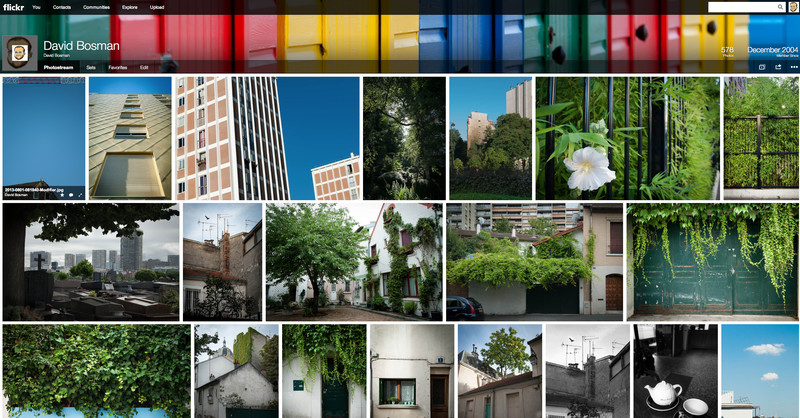
Quelques photos dans Paris

Si ça vous intéresse, je vais tenter de publier régulièrement les photos de mes promenades matinales. Aucune idée de la façon dont ça évoluera, prenez ça comme un bloc-notes photographique à feuilleter — dont nous pouvons éventuellement discuter, si ça vous dit — sur Flickr :

Promenades.png

Ah oui, j’ai décelé un thème récurrent : Paris et la verdure, à qui j’ai donné son propre album : Paris en vert — quelle imagination.