A Preliminary Atlas of Drone Strike Landscapes

It is difficult to describe a drone strike accurately.

On October 24, 2012, Bibi Mamana and her grandchildren were gathering firewood or picking okra outside their home. They may have been in a field. Perhaps it was a militant compound with a weapons depot. 2 missiles were fired, killing Mamana and up to 5 other people, injuring 6 to 8 of the children. Some other men, maybe 3, maybe militants, may have been caught in the blast. A house and a car may or may not have been destroyed. Either 3 cows or 1 buffalo and 2 goats were also killed. The drones remained overhead and 5 to 7 minutes after the first strike more missiles fell.

This moment—the drones, the missiles, the people, the livestock—is a node in a vast network. It spans the globe, connecting villages to secret installations to office parks to seats of government. It reaches backwards for millenia and will resonate forwards for untold centuries. To trace it out completely is impossible. We are hampered by its size and by the fact that much of it is hidden behind classified protections and some of the rest is barely recorded at all.

This is an attempt to understand the geography of a drone strike.

(…)

Like his predecessors, Petraeus used ‘signature’ strikes to select and destroy targets. Unlike ‘personality’ strikes, where the target is a positively identified terrorist leader or some other high value individual, signature strikes involve looking for behaviour patterns to identify groups of men who appear to be behaving like terrorists, whether or not their identities are definitively known.

One of the claimed benefits of this approach is that it makes militants more reluctant to congregate, for fear of being droned, which in turn makes it harder for them to train, or plot against the United States. This is a remarkable approach to counter-insurgency. It’s an attempt to identify and control the enemy in a frontless war by making targetting determinations based solely on how people move through the landscape. Invisible panoptical sky gods rain HELLFIRE down upon the possibly guilty, to scare the rest into submission. Dominance through terror.

OB298 — A Preliminary Atlas of Drone Strike Landscapes

Even remotely — pun intended? — it is not entirely unrelated with this or even this posts.

Merci, Olivier

Rentrer de ma promenade photo matinale pour découvrir, perdu entre les factures et les pubs, une boite de chocolats suisse envoyée par un lecteur du blog, c’est plutôt sympabon — un très grand merci à Olivier pour ce savoureux cadeau 🙂

Pas de photo ? Non. J’ai deux excuses à vous proposer pour me faire pardonner, je vous laisse choisir la plus crédible :

  • L’iPhone n’avait plus de batterie.
  • J’ai déjà mangé les chocolats.

Miam.

Pour faire suite au Bad Dream

As a follow up to the previous post, a very interesting talk from Eric X. Li : A tale of two political systems — thank you Richard, for the link.

Democraty is becoming a perpetual cycle of elect and regret.
(…)
meta-narrative is the cancer that is killing democracy from the inside. (…)
(…)
China political model (…) doesn’t pretend to be universal, it can not be exported. (… It is) the demonstration that an alternative exists. (…) Let universality make way for plurality.

A Bad Dream

Democracy is a rather crap form of government, with several failure modes (of which the tendency to converge on an oligarchy is but one), but it has one huge advantage over other forms of government: it provides a mechanism for peacefully transferring power when a governing clique has outlived its popularity. We hold elections, not civil wars: we kick the bums out, their replacements clean house, and some time later the bums — chastened and perhaps minus some old, familiar, unpopular faces — get another chance.

But with the Ruling Party consolidating its grip on the front benches of the Nominal Parties — and this is not merely a problem in the UK, but in Canada, Australia, and elsewhere — the mechanism for ensuring a peaceful succession has broken down.

Moreover, we are now discovering that we live in a panopticon, in houses of glass that are open to inspection and surveillance by the powers of the Deep State. Our only remaining form of privacy is privacy by obscurity, by keeping such a low profile that we are of no individual interest to anyone: and even that is only a tenuous comfort. Any attempt at organizing a transfer of power that does not ring the changes and usher in a new group of Ruling Party faces to replace the old risks being denounced as Terrorism.

Charles Stross: A Bad Dream.

Zooey Deschanel demande (gentiment) de ne plus faire de photo durant ses concerts

Zooey Deschanel the Latest Musician to Impose Anti-Photo Policy.

Si cette “politique” anti-photo de concert — qu’elle soit motivée par la rapacité (le droit à l’image), par le désir de contrôler l’image de l’artiste (ne surtout pas avoir l’air con sur une photo), par le souci de “proposer une expérience d’immersion totale dans le concert” (elle est rigolote cette excuse-là) — ne vous plaît pas, vous disposez d’un moyen simple de le faire savoir à l’artiste : n’allez plus à ses concerts.

Si la vente de billets chute, il/elle sera bien obligé de comprendre que laisser les amateurs de sa musique prendre des images durant les concerts n’est pas une si mauvaise idée que ça.

Il n’y a pas de gentil ou de méchant dans l’histoire, ni de bien ou de mal, seulement des habitudes et de l’absence de réflexion. C’est à chacun de nous de faire en sorte que la photo cesse d’être considérée comme quelque chose d’illégal, d’horrible, de dévalorisant ou même comme un vol — on parle trop souvent de “voler une image”.

Crier au scandale ne sert à rien. C’est à chacun de nous d’agir pour changer ça, même si ça veut dire se priver d’un (chouette) concert pour faire passer le message aux artistes.

Pour rester fidèle à ma réputation de râleur, une dernière question — que les clients pourraient poser à Monsieur Nikon, Canon, Olympus, Apple & Co : est-il encore intéressant d’acheter un appareil photo (reflex ou smartphone) vu le peu de photos que l’on est encore en droit de faire sans être embêté ou inquiété ? Ils devraient se sentir concernés, eux aussi.

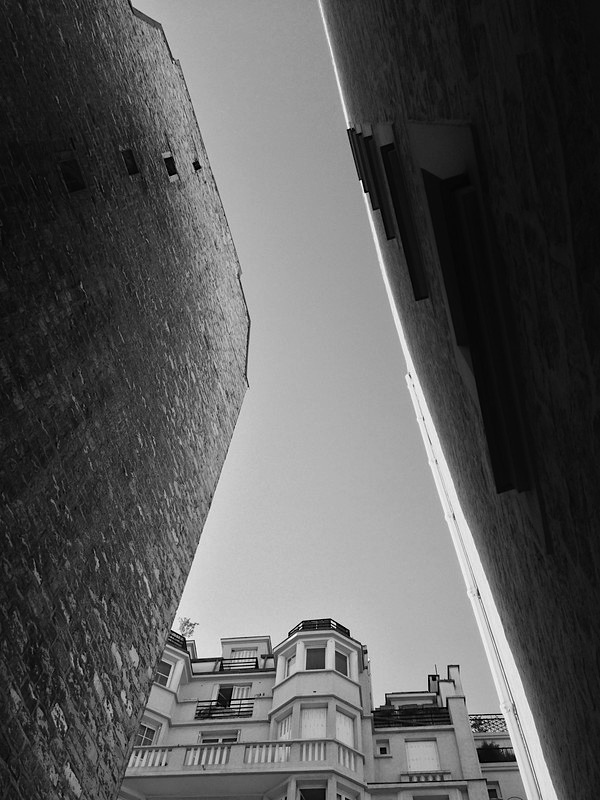
2013 07 09 08.25.14 hdr.jpg
(iPhone 5 + VSCOCam. Prise hier du côté de la Butte aux cailles, Paris)